
Tek speak :)
- hello593537
- Dec 29, 2025
- 3 min read
Behind every reliable IoT solution is the right communication protocol ensuring secure, efficient, and scalable data exchange. Here are some of the most important IoT protocols every IoT professional should know and every prospective client should ask about:
🔹 MQTT – Lightweight, publish/subscribe protocol ideal for low-bandwidth networks
🔹 HTTP / HTTPS – Widely used for REST-based IoT applications and cloud integration
🔹 CoAP – Optimized for constrained devices and low-power environments
🔹 AMQP – Reliable message queuing for enterprise-grade IoT systems
🔹 Modbus (TCP/RTU) – Common in industrial IoT and SCADA systems
🔹 OPC UA – Secure, platform-independent communication for industrial automation
🔹 LoRaWAN – Long-range, low-power protocol for remote IoT deployments
🔹 Zigbee – Low-power mesh networking for sensors and smart devices
🔹 NB-IoT / LTE-M – Cellular protocols designed for massive IoT deployments
🔹 DDS – Real-time, high-performance data exchange for mission-critical systems

Thank you to K.Harsha, P. Oluwadunsin Ojo, B. Thirumalaivasan
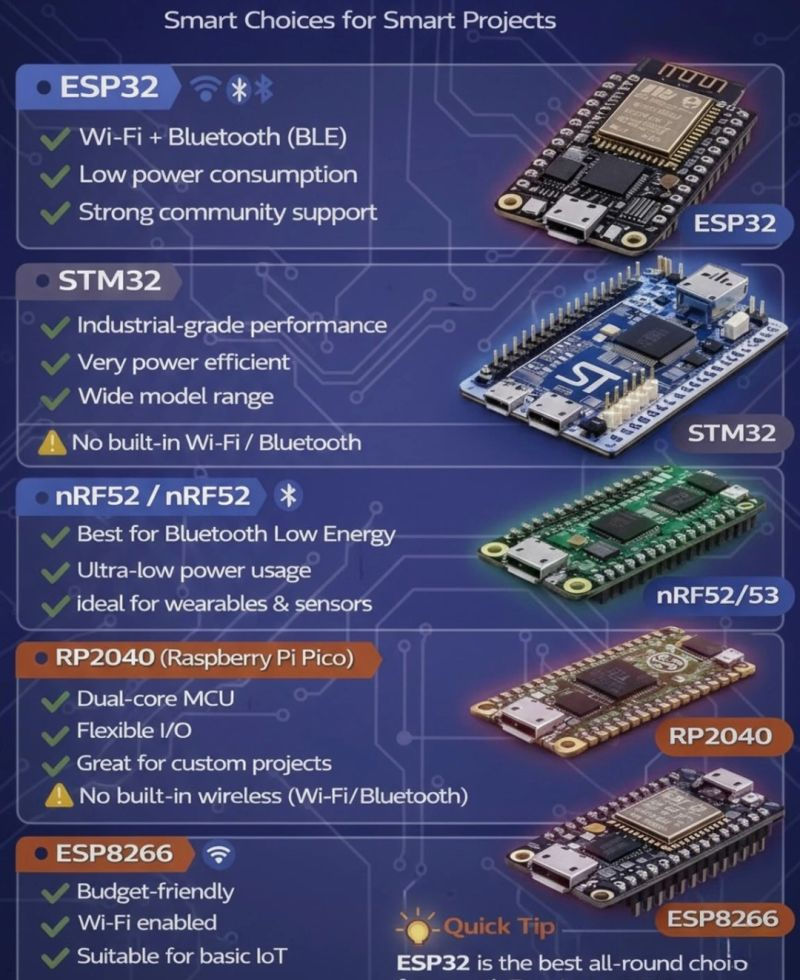
ESP32 is one of the most popular microcontrollers for modern IoT projects. With built-in Wi-Fi and Bluetooth (BLE), it enables seamless wireless communication without extra modules. Its low power consumption and strong open-source community make it ideal for smart home systems, industrial monitoring, and connected devices. A great all-rounder for beginners and professionals alike.
STM32 microcontrollers are designed for industrial-grade performance and reliability. Known for their power efficiency and wide range of variants, they are widely used in automation, motor control, medical devices, and embedded systems. While they don’t include built-in Wi-Fi or Bluetooth, their performance and scalability make them a top choice for professional embedded applications.
The nRF52/53 series is optimized for Bluetooth Low Energy (BLE) applications. With ultra-low power consumption, these microcontrollers are perfect for wearables, wireless sensors, and battery-powered devices. They are commonly used in health tech, IoT sensors, and smart accessories where power efficiency is critical.
#RP2040 (Raspberry Pi Pico)
RP2040 is a powerful dual-core microcontroller from Raspberry Pi, known for its flexible I/O and high performance at low cost. It is excellent for custom hardware projects, robotics, and learning embedded systems. Although it lacks built-in wireless connectivity, its programmability and community support make it a favorite among makers and engineers.
ESP8266 is a budget-friendly Wi-Fi microcontroller that played a major role in the rise of IoT. It is well-suited for basic IoT applications such as smart switches, data logging, and simple automation projects. Despite being older than ESP32, it remains a solid choice for cost-sensitive wireless projects.
BENEFITS OF IoT TO ELECTRICAL ENGINEERING
1. REAL-TIME SYSTEM MONITORING
IoT enables electrical engineers to monitor voltage, current, power quality, and equipment status in real time, improving system reliability.
2. PREDICTIVE MAINTENANCE
Sensor data helps detect faults early in transformers, motors, inverters, and substations, reducing downtime and maintenance costs.
3. SMART GRID DEVELOPMENT
IoT supports intelligent power generation, transmission, and distribution through automation, load balancing, and fault detection.
4. ENERGY EFFICIENCY OPTIMIZATION
Electrical systems can be optimized by monitoring consumption patterns and minimizing energy losses.
5. REMOTE CONTROL AND AUTOMATION
Engineers can control breakers, relays, and switchgear remotely, improving response time during faults or emergencies.
4. IMPROVED POWER QUALITY
IoT devices help detect harmonics, voltage sag, and frequency variations, ensuring stable power delivery.
5. INTEGRATION OF RENEWABLE ENERGY
IoT enables effective monitoring and management of solar, wind, and hybrid power systems.
6. ENHANCED SAFETY
Early detection of overloads, overheating, and insulation failures reduces electrical hazards.
7. DATA-DRIVEN DESIGN AND PLANNING
Collected field data helps engineers design more efficient and reliable electrical systems.
8. CAREER AND SKILL ADVANTAGE
IoT knowledge gives electrical engineers a competitive edge in smart energy, automation, and Industry 4.0 roles.


